Blog
How Predictive CLV Turns Customer Data into Lifecycle Decisions
Subscription businesses generate vast amounts of customer data, but most decisions still rely on historical performance rather than anticipating future customer value.
As a result, acquisition prioritizes conversion over long-term value; retention comes too late, and growth remains broad and undifferentiated.
The problem is not data. It is decisions being made without visibility into future value of a subscriber. The challenge is translating that value into actionable decisions across the customer lifecycle.
In our recent article, The Invisible Tax on Growth, we showed how reliance on historical revenue leads to misallocated resources and missed opportunities.
Predictive Customer Lifetime Value (PCLV) addresses this by shifting decision-making from what customers have done to what they are likely to be worth.
Its impact comes when these insights drive decisions across acquisition, retention, and growth.
In this blog, we explore how VOZIQ AI helps subscription businesses transform customer data into actionable lifecycle decisions across four key areas of growth, followed by a case study.
1. Customer Microsegmentation – Move beyond static segments to behavior- and value-driven customer groups
2. GET (Acquisition) – Focus on acquiring customers based on future value, not just conversion
3. KEEP (Retention) – Proactively reduce churn using early risk signals
4. GROW (Expansion) – Identify pricing and upsell opportunities with precision
5. Frontpoint’s $20M-CLV success story – How a leading home security subscription brand used these strategies to achieve lowest ever attrition rates in their history and realized $20 million in customer lifetime value
1. Customer Micro segmentation:
The first step in making predictive CLV actionable is microsegmentation.
Most subscription companies group customers using broad categories such as plan type, tenure, or geography. While useful for reporting, these segments rarely reflect how customers actually behave or what actions they require.
Predictive models analyze patterns across billing data, service interactions, product usage, and other signals to identify customers who share similar behavioral and value characteristics.
These insights allow organizations to create microsegments that reflect the true dynamics of the customer base.
Microsegmentation is not just a way to group customers, it is how organizations operationalize value-based decision-making.
The illustration below shows how predictive micro segmentation transforms a broad, undifferentiated customer base into targeted groups aligned with specific business actions.
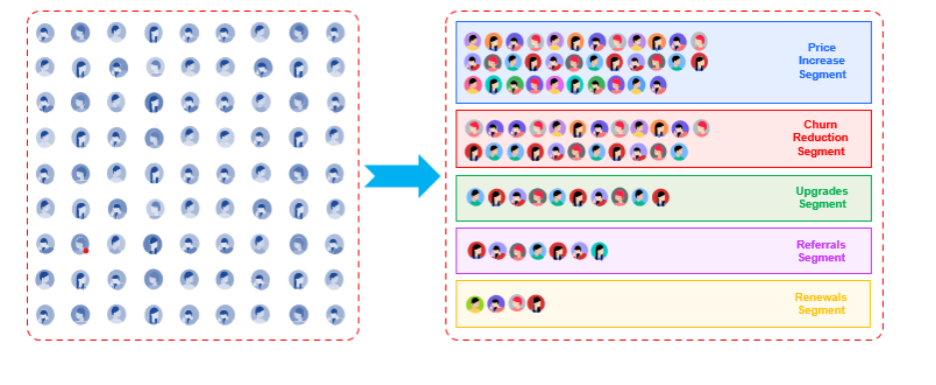
Instead of treating every customer the same way, predictive models organize subscribers into actionable segments—such as customers who require churn intervention, those ready for upgrades, those suitable for price adjustments, or those most likely to drive referrals and renewals.
For example, a microsegment might include:
• High-value customers in dense markets with strong engagement signals
• Newly acquired customers using only basic services
• Budget-conscious customers who frequently negotiate pricing
Each segment represents a different customer relationship—and therefore requires a different strategy.
2. GET – Acquiring Profitable Subscribers
The acquisition phase is where many companies unknowingly create future churn.
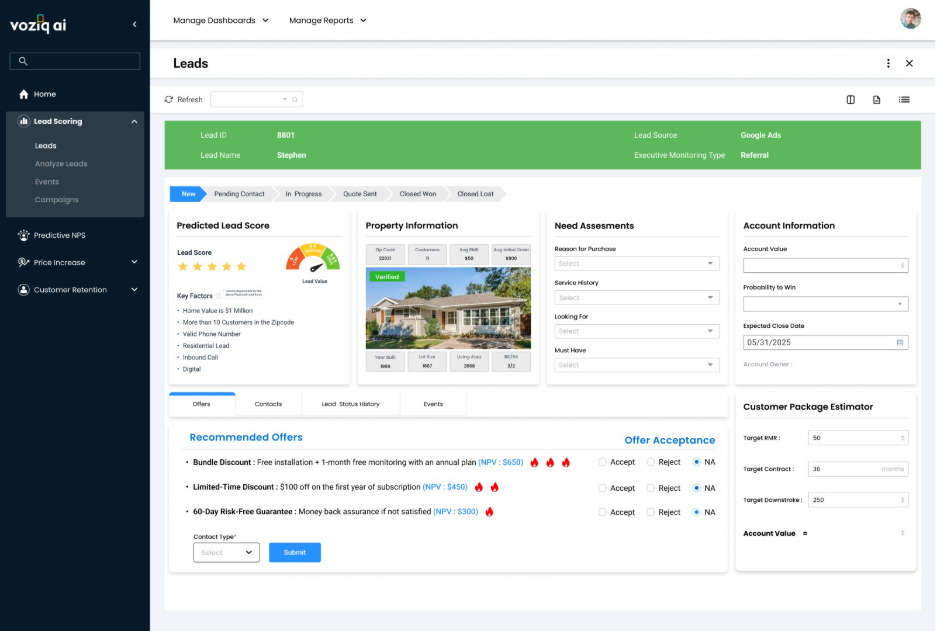
Most organizations evaluate leads only by their likelihood to convert. But conversion alone does not guarantee profitability. The real question is whether a lead is likely to become a high-value customer over time.
Predictive CLV answers this question before a lead becomes a subscriber. By combining first-party data with external signals—such as acquisition source, property attributes, and demographic indicators—models estimate both conversion probability and potential lifetime value.
When leads are evaluated across these two dimensions—conversion propensity and predicted value—companies gain a clearer view of where to focus acquisition efforts. Some prospects warrant stronger incentives because they resemble your most loyal customers, while others may convert easily but generate limited long-term value.
This shift changes the acquisition mindset from How many customers can we acquire? to Which customers should we acquire?
3. KEEP – Extending Customer Lifetime
Retention is where predictive intelligence begins transforming operations.
Traditionally, retention teams act only when customers signal cancellation. By that point, the decision to leave may already be made. This leads to aggressive retention offers which are unprofitable and still fail to retain customers who might have already made the switch.
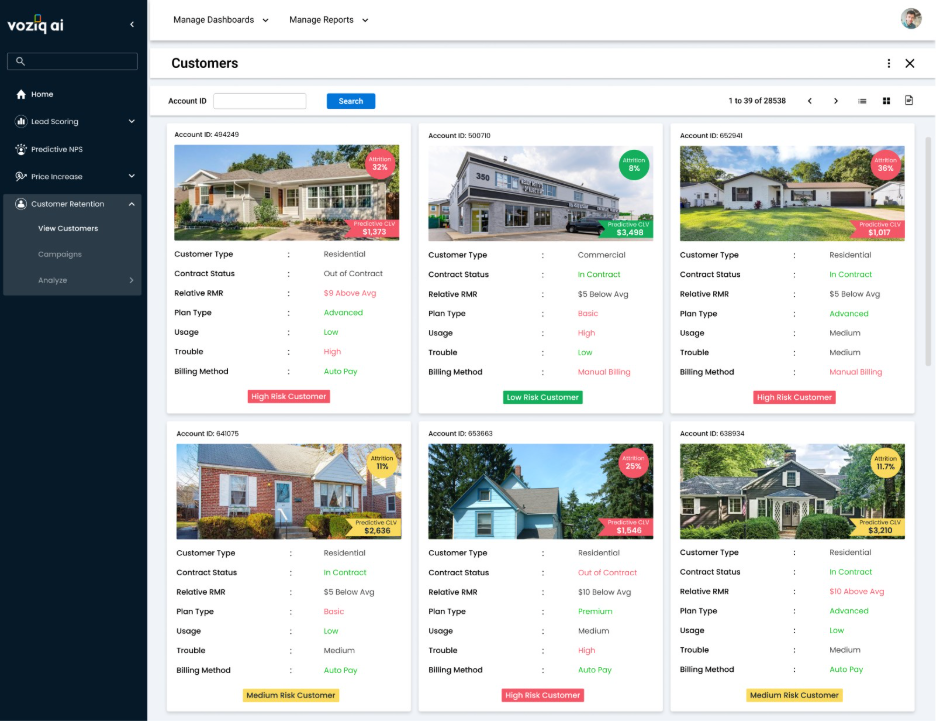
Predictive CLV allows organizations to identify risk much earlier and segment risk by future value. By analyzing behavioral signals—service interactions, engagement patterns, usage trends, and revenue contribution—models assign both churn risk and forward-looking lifetime value to every subscriber.
This enables companies to create microsegments based on value and risk. High-value customers showing early signs of dissatisfaction can receive proactive outreach, service improvements, or tailored incentives before the relationship deteriorates.
For subscription leaders, this represents a shift from reactive retention to proactive churn prevention which deals with root causes and is more targeted and profitable.
4. GROW – Expanding Customer Value
Predictive CLV also helps identify opportunities to grow revenue from existing customers.
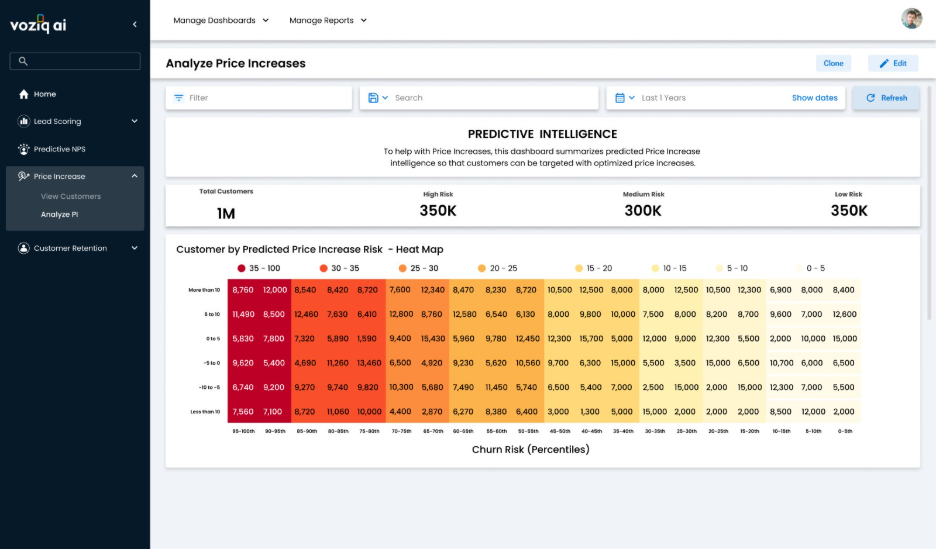
By analyzing customer plans, usage behavior, and revenue metrics such as MRR or ARR, models estimate both relative pricing and price sensitivity for each subscriber.
When customers are segmented along these dimensions, companies gain a clearer view of where growth opportunities exist. Customers already paying above average and highly sensitive to price may require stabilization strategies, while those paying below average with low sensitivity may present opportunities for upgrades or price adjustments.
This enables more precise growth strategies—replacing broad campaigns with actions aligned to actual customer behavior.
5. How Frontpoint Operationalized Predictive CLV
A strong example of how predictive CLV and microsegmentation translate into real business outcomes comes from Frontpoint, a leading home security provider in North America.
Frontpoint applied predictive CLV models to analyze customer behavior, engagement signals, and renewal patterns. Instead of relying on uniform renewal campaigns, the company implemented risk-based renewals powered by predictive microsegmentation.
These insights allowed Frontpoint to identify customers with higher churn risk and proactively guide renewal strategies through both contact center interactions and automated web portal experiences.
By aligning renewal strategies with predicted customer value and risk signals, Frontpoint was able to operationalize predictive CLV across its customer lifecycle.
The results were significant:
- $20M increase in customer lifetime value
- 250 bps reduction in attrition
- 10,000+ risk-based renewals within 18 months
- 33-month average renewal length
This example highlights how predictive CLV can move beyond analytics and become a practical framework for guiding customer engagement, retention, and renewal strategies.
Turn Predictive Insights into Action
Turning customer data into decisions requires more than analytics; it requires the ability to operationalize predictive insights at scale.
Predictive CLV provides the foundation for this shift, enabling organizations to move from retrospective analysis to forward-looking, value-driven execution.
VOZIQ AI helps subscription businesses operationalize predictive CLV through AI-driven micro segmentation and targeted customer strategies that improve retention, optimize pricing, and grow long-term customer value.
Start your Complimentary Proof of Value Trial and see how predictive CLV works with your own data.
FAQs
1. How is predictive CLV different from traditional CLV?
Traditional CLV is based on historical revenue, while predictive CLV estimates lifetime for every subscriber based on risk modeling and calculates value over their predicted lifetime. This approach enables proactive and profitable actions across acquisition, retention, and growth.
2. Why is microsegmentation important for subscription businesses?
Microsegmentation allows businesses to group customers based on predicted risk, predicted value, and business logic. This enables highly targeted and personalized actions instead of one-size-fits-all strategies.
3. How does predictive CLV improve customer acquisition?
It helps identify which leads are more likely to become high-value customers, allowing teams to prioritize acquisition efforts based on long-term value, not just conversion.
4. Can predictive CLV reduce churn?
Yes. By identifying early risk signals and combining them with customer value, businesses can proactively intervene before churn occurs and focus proactive retention efforts on high-risk, high-value customers.
5. How does predictive CLV support revenue growth?
It identifies opportunities for high-value upsell and referrals, and pricing optimization by analyzing price sensitivity and future value.