Blog
The Invisible Tax on Growth: Why Executive Teams Unintentionally Work at Cross-Purposes
For most subscription enterprises, the greatest threat to growth isn’t the market - it is a lack of alignment at the top. While every leader wants to increase company value, they often work against each other because they are looking at the business through the rearview mirror of historical revenue.
This creates an "invisible tax" on your growth. It leads to wasted marketing spend, reactive customer service, and capital being moved to the wrong places.
The Friction: A Leadership Team Divided by Data
When top executives and their teams rely on different, backward-looking metrics, they unintentionally pull the business in different directions. This friction is a result of siloed execution where everyone drives toward the same goal but uses a different map. This manifests in three specific ways:
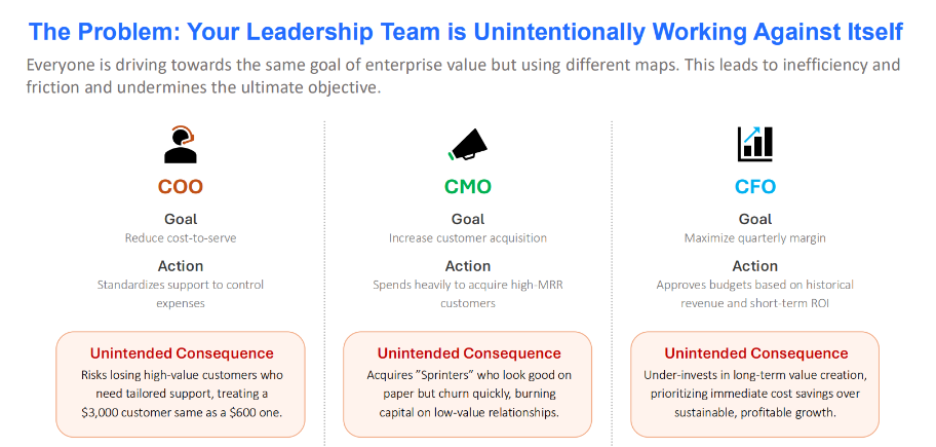
The CFO and the Capital Trap: Without a view of future value, the CFO often approves budgets based on historical revenue and short-term ROI. This leads to under-investing in long-term value creation and prioritizing immediate savings over sustainable growth.
The CMO and the Acquisition Gap: Marketing teams often spend heavily on acquiring high-revenue customers to hit monthly targets. However, if these "Sprinters" look good on paper but churn quickly, the company burns capital on low-value relationships.
The COO and the Reactive Loop: To control expenses, operational teams often standardize support. These risks are losing high-value customers who need tailored, differentiated support to stay loyal.
The Root Cause: The High-Revenue Illusion
These silos exist because organizations manage current billing rather than future potential. This leads to the "High-Revenue Illusion," where teams mistake expensive, short-term subscribers for long-term growth engines.
Consider the difference between two customers:
Customer A: Pays 100 dollars per month but cancels after six months, generating only 600 dollars in total revenue.
Customer B: Pays 50 dollars per month but stays for five years, generating 3,000 dollars in total revenue.
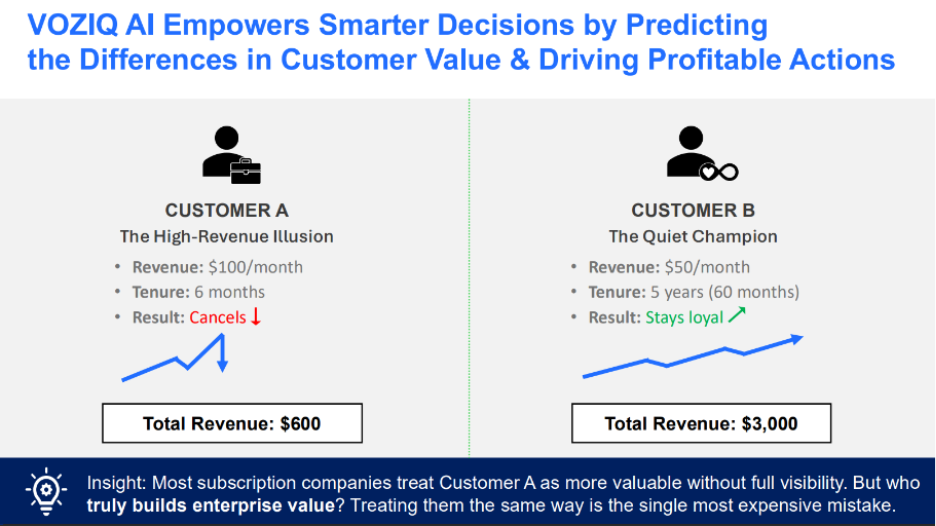
Without predictive intelligence, your marketing team will spend more to find "Sprinters" like Customer A, while your service team ignores "Champions" like Customer B. Treating these two customers the same is the single most expensive mistake a subscription business can make.
How VOZIQ AI Changes the Outcome with Predictive CLV
VOZIQ AI Solve this friction by replacing historical reports with a forward-looking system. Our technology analyzes customer data to calculate Predictive Customer Lifetime Value: the predicted net profit a customer will generate over the full duration of their relationship.
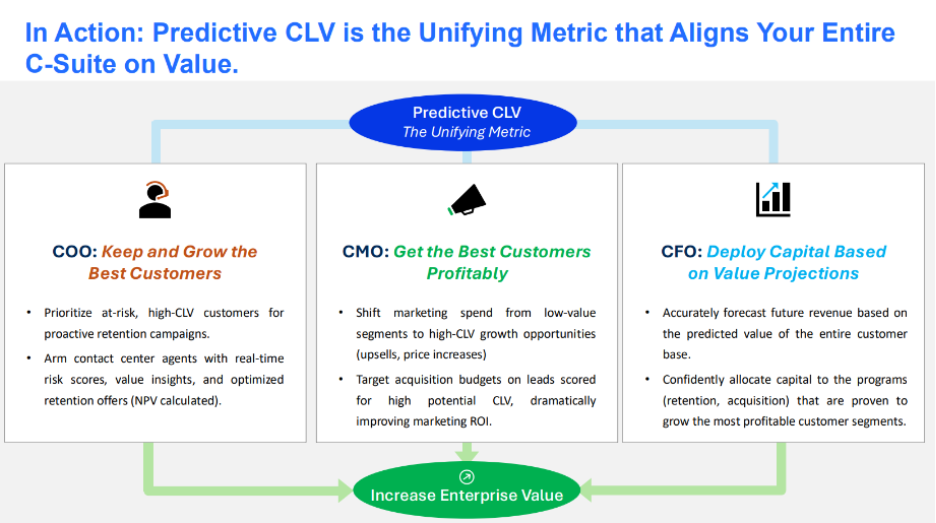
By using Predictive CLV as a unifying metric, VOZIQ AI aligns the executive team on a single definition of value:
The CFO can deploy capital with confidence, investing in programs that are proven to grow the most profitable customer segments.
The CMO can shift spend away from short-term "sprinters" and toward acquiring look-alike customers modeled after your highest-value segments.
The COO can identify high-value customers showing early signs of risk and intervene with proactive, targeted retention campaigns.
Measured Impact: Moving AI from Experiment to Execution
Predictive insights are only useful if they change the bottom line. VOZIQ AI focuses on moving AI beyond isolated analytical wins and into repeatable business impact. By combining predictive AI with execution aligned to real business decisions, our partners have realized significant results:
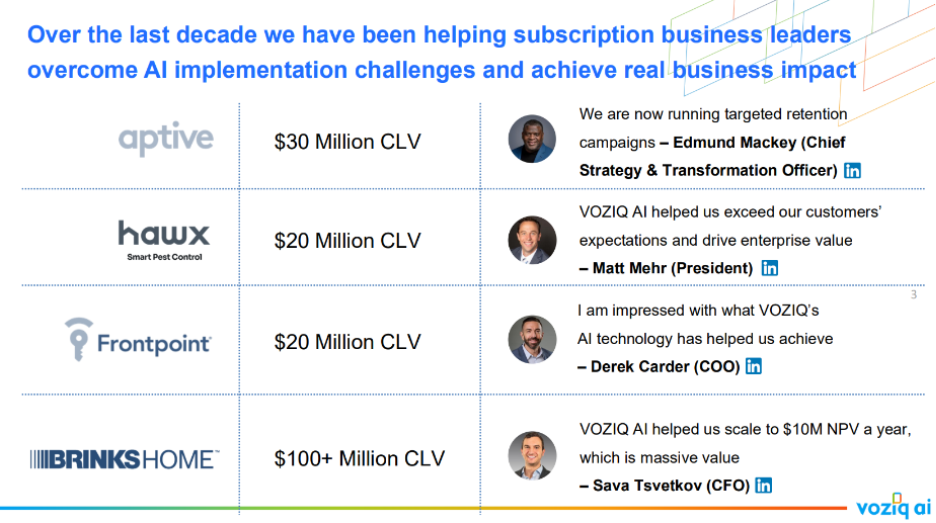
The shift to a predictive model should not be a leap of faith. It should be a business decision backed by your own data. VOZIQ AI offers a Complimentary Proof-of-Value Program for subscription businesses to validate this impact.
In this trial, we show you exactly how comparing customers by future value instead of current revenue would change your retention, growth, and capital allocation decisions.
Stop managing the rearview mirror. You can see the future of your business by using the data you already have.
Proof of Value Briefing here: https://www.voziq.ai/production-trial